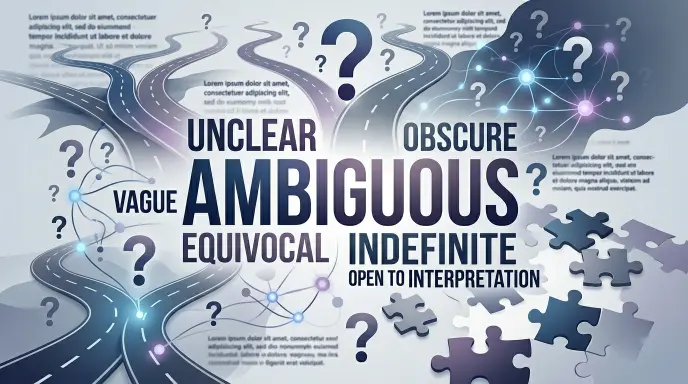
Have you ever read a sentence and wondered what it really means? Maybe a teacher gave instructions that seemed unclear, or a friend sent a message that could be understood in different ways. This often happens when something is ambiguous.
For example, imagine a manager telling employees, “Finish the report soon.” One employee thinks “soon” means today, while another believes it means sometime this week. The instruction is ambiguous because it can have more than one interpretation.
The word ambiguous means something that is unclear, uncertain, or open to different meanings. Learning the synonyms of ambiguous can help students, bloggers, content writers, and English learners communicate more effectively.
Using different words instead of repeating the same one makes your writing stronger, more professional, and easier to read.
1. Unclear
Meaning: Not easy to understand.
Explanation: Used when information lacks clarity.
Examples:
- The teacher’s instructions were unclear.
- His answer was unclear and confused everyone.
2. Vague
Meaning: Not expressed clearly.
Explanation: Gives limited details.
Examples:
- She gave a vague explanation.
- The directions were too vague to follow.
3. Uncertain
Meaning: Not definite or sure.
Explanation: Indicates doubt or confusion.
Examples:
- The future remains uncertain.
- We were uncertain about the outcome.
4. Confusing
Meaning: Difficult to understand.
Explanation: Causes misunderstanding.
Examples:
- The map was confusing.
- His explanation sounded confusing.
5. Equivocal
Meaning: Open to multiple interpretations.
Explanation: Can be understood in different ways.
Examples:
- Her response was equivocal.
- The statement remained equivocal.
6. Obscure
Meaning: Hard to understand.
Explanation: Not clear or obvious.
Examples:
- The meaning was obscure.
- He used obscure language.
7. Indefinite
Meaning: Not clearly defined.
Explanation: Lacks exact limits.
Examples:
- The deadline was indefinite.
- They gave an indefinite answer.
8. Doubtful
Meaning: Uncertain or questionable.
Explanation: Creates uncertainty.
Examples:
- His intentions were doubtful.
- The results remain doubtful.
9. Puzzling
Meaning: Difficult to explain.
Explanation: Makes people think hard.
Examples:
- The clue was puzzling.
- Her behavior seemed puzzling.
10. Cryptic
Meaning: Having a hidden meaning.
Explanation: Difficult to understand directly.
Examples:
- He sent a cryptic message.
- The note was cryptic.
11. Enigmatic
Meaning: Mysterious and hard to understand.
Explanation: Creates curiosity.
Examples:
- She had an enigmatic smile.
- His motives were enigmatic.
12. Mysterious
Meaning: Difficult to explain.
Explanation: Not fully understood.
Examples:
- The disappearance was mysterious.
- He gave a mysterious answer.
13. Dubious
Meaning: Questionable or uncertain.
Explanation: Causes doubt.
Examples:
- The claim seemed dubious.
- They offered dubious evidence.
14. Inexact
Meaning: Not precise.
Explanation: Lacks accuracy.
Examples:
- The measurements were inexact.
- His description was inexact.
15. Imprecise
Meaning: Not exact or accurate.
Explanation: Missing specific details.
Examples:
- The wording was imprecise.
- Her explanation remained imprecise.
16. Ambivalent
Meaning: Having mixed feelings.
Explanation: Shows uncertainty.
Examples:
- She felt ambivalent about moving.
- He was ambivalent toward the proposal.
17. Questionable
Meaning: Open to doubt.
Explanation: Not fully reliable.
Examples:
- The source was questionable.
- Their reasoning seemed questionable.
18. Misty
Meaning: Not clear.
Explanation: Often used figuratively.
Examples:
- His memory was misty.
- The details remained misty.
19. Shadowy
Meaning: Vague or unclear.
Explanation: Difficult to identify clearly.
Examples:
- The figure looked shadowy.
- The facts were shadowy.
20. Murky
Meaning: Dark and unclear.
Explanation: Difficult to understand.
Examples:
- The situation was murky.
- The explanation remained murky.
21. Foggy
Meaning: Not clear in thought or meaning.
Explanation: Lacks clarity.
Examples:
- My memory is foggy.
- The instructions were foggy.
22. Perplexing
Meaning: Very confusing.
Explanation: Difficult to understand.
Examples:
- The puzzle was perplexing.
- His actions were perplexing.
23. Unresolved
Meaning: Not settled or clarified.
Explanation: Still uncertain.
Examples:
- The issue remains unresolved.
- Many questions are unresolved.
24. Elusive
Meaning: Difficult to understand or define.
Explanation: Hard to grasp.
Examples:
- Success can be elusive.
- The meaning remained elusive.
25. Indistinct
Meaning: Not clearly seen or understood.
Explanation: Lacking definition.
Examples:
- The image was indistinct.
- His words sounded indistinct.
26. Cloudy
Meaning: Not clear or transparent.
Explanation: Creates uncertainty.
Examples:
- The explanation was cloudy.
- The issue remains cloudy.
27. Undefined
Meaning: Not clearly described.
Explanation: Missing a precise meaning.
Examples:
- The role was undefined.
- Their goals were undefined.
28. Unspecified
Meaning: Not stated clearly.
Explanation: Details are missing.
Examples:
- The date was unspecified.
- The requirements remained unspecified.
29. Conflicted
Meaning: Torn between different views.
Explanation: Shows uncertainty.
Examples:
- She felt conflicted.
- He was conflicted about the decision.
30. Interpretive
Meaning: Open to interpretation.
Explanation: Can be understood differently.
Examples:
- The artwork is interpretive.
- The statement was highly interpretive.
FAQs About Synonyms of Ambiguous
What does ambiguous mean?
Ambiguous means something is unclear and can have more than one meaning.
Why should I learn synonyms of ambiguous?
They improve writing, speaking, blogging, SEO content creation, and daily communication.
What is the most common synonym of ambiguous?
“Vague” is one of the most common synonyms.
Is ambiguous always negative?
No. Writers often use ambiguity intentionally in literature and poetry.
Can ambiguous and vague be used interchangeably?
Often yes, but vague means lacking details while ambiguous means having multiple possible meanings.
Conclusion
Learning the synonyms of ambiguous can significantly improve your vocabulary and writing quality. Whether you are a student, blogger, content writer, teacher, or English learner, these alternative words help you express ideas more accurately and professionally.
Instead of repeatedly using the word ambiguous, you can choose words like vague, unclear, cryptic, enigmatic, obscure, or murky depending on the context. This variety makes your writing more engaging and SEO-friendly.
Practice using these synonyms in emails, essays, articles, blog posts, and everyday conversations. Over time, they will become a natural part of your vocabulary and help you communicate with greater confidence.

I am Johnny Lee is a passionate writer and language enthusiast dedicated to making English grammar simple, practical, and easy to understand. Through grameases.com, he helps learners improve their English skills with clear explanations.