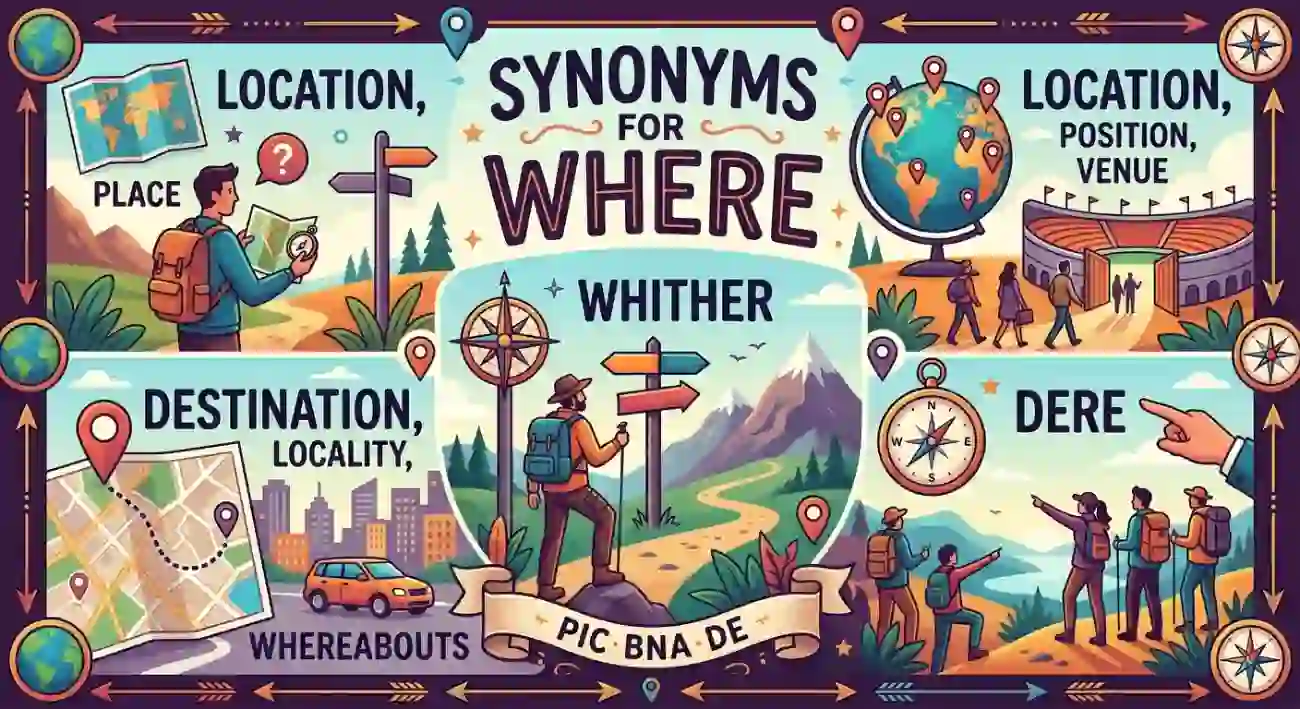
A synonym for where depends on the sentence and its meaning. Useful alternatives include whereabouts, wherever, in which, at which, to which, and at what place.
Words such as location, place, site, and position describe locations but do not always replace “where” directly. Choose an alternative that fits your sentence naturally.
Key Takeaways
- Whereabouts works when asking about someone’s location.
- Wherever means any place or every place that meets a condition.
- In which and at which can replace “where” in some formal sentences.
- Location, place, site, and position are related words, not universal substitutes.
- Always check the sentence’s meaning and grammar before choosing a synonym.
What Is Another Word for Where?
The best synonym for where depends on how you use the word. In questions, “where” asks about a place or location. In other sentences, it connects information about a place, situation, or stage of an activity.
Cambridge Dictionary
+1
For example, you might ask, “Where is the nearest grocery store?” In formal writing, you might say, “The building in which the meeting took place was recently renovated.”
Both sentences concern location, but their structures differ. That is why choosing a synonym requires more than finding a similar word in a thesaurus.
Common Alternatives for Everyday Writing
Here are some useful alternatives and related expressions:
- Whereabouts: Asks about someone’s location.
- Wherever: Refers to any place or every place that fits a condition.
- In which: Refers to a place or setting within which something happens.
- At which: Refers to a particular point, place, or event.
- To which: Indicates a destination or direction.
- At what place: A more explicit way to ask about a location.
- Location: Names the place where something is situated.
- Site: Refers to a specific place, often one used for a particular purpose.
Remember that some options are grammatical alternatives, while others are related vocabulary. They cannot all be substituted for “where” without changing the sentence.
20 Synonyms and Alternatives for Where
The following list explains when each alternative is useful and provides an original example.
Direct and Conversational Alternatives
1. Whereabouts
Use this word when asking about a person’s location or the general area where something can be found.
Example: Do you know her whereabouts during the afternoon?
2. Wherever
Use “wherever” to mean any place or every place that meets a condition.
Example: You can sit wherever you feel comfortable.
3. Anywhere
This word refers to any place and often appears in questions or negative statements.
Example: Is there anywhere nearby where we can get lunch?
4. At what place
This phrase makes a location question more explicit, although it often sounds less natural than “where” in everyday conversation.
Example: At what place will the ceremony begin?
5. In what location
This expression works in formal questions, surveys, reports, or instructions that require a specific location.
Example: In what location was the equipment stored?
6. In which
Use this phrase when referring to a place or setting already mentioned.
Example: We visited a quiet village in which several artists lived.
7. At which
This phrase can refer to a specific place, point, or event.
Example: The museum at which we met has a new exhibition.
8. To which
Use this expression when the sentence describes movement toward a destination or a connection to a particular place.
Example: The town to which they moved is close to the coast.
9. From which
This phrase identifies the place or source something comes from.
Example: The farm from which the vegetables came follows organic growing practices.
10. Through which
Use this phrase to describe movement through a place or passage.
Example: We walked through the tunnel through which the river once flowed.
Formal and Literary Alternatives
11. Whither
“Whither” means “to what place” or “in what direction.” It is an uncommon, old-fashioned word that appears mainly in literary or poetic writing.
Example: Whither shall we travel when the journey ends?
12. Whereto
This literary term means “to what place” or “to what purpose,” depending on context. It is rarely used in modern everyday American English.
Example: The old poem asks where the traveler should turn.
13. Wherein
“Wherein” means “in which” or “in what respect.” It is most useful in formal, legal, or literary contexts.
Example: The report describes the circumstances wherein the disagreement began.
14. At the point where
This phrase is useful when discussing a specific stage, moment, or location.
Example: Stop at the point where the road divides.
15. The place in which
This longer expression provides a formal alternative when describing a specific setting.
Example: The garden is the place in which the children learn about plants.
Location-Related Words
These words are related to “where” because they describe places or positions. However, they are nouns and usually require a different sentence structure.
16. Location
Refers to the position or place of a person, object, or event.
Example: Please confirm the location of the conference.
17. Place
A general word for an area, building, or setting.
Example: This is the place where we first met.
18. Site
Refers to a particular location, often associated with an activity, building, or event.
Example: The construction site is closed to visitors.
19. Position
Describes the physical placement or relative location of something.
Example: Check the position of the desk before moving it.
20. Locale
Refers to the setting or general area where an event occurs, especially in descriptive or literary writing.
Example: The coastal locale gives the story a peaceful atmosphere.
Best Synonyms for Where in Different Contexts
Not every alternative works in every situation. Use this table to select the expression that best matches your intended meaning.
| Context | Best alternative | Example |
| Asking about a person’s location | Whereabouts | What is his whereabouts? |
| Referring to any suitable place | Wherever | Sit wherever you like. |
| Formal writing | In which | The room in which we met was quiet. |
| Referring to a particular point | At which | The stage at which progress slowed was unexpected. |
| Describing a destination | To which | The city to which she traveled was beautiful. |
| Identifying a source | From which | The river from which we collected water was clean. |
| Describing a physical place | Location | The location is easy to find. |
| Describing a specific setting | Locale | The locale adds charm to the story. |
The best choice also depends on tone. Everyday conversation usually favors simple, familiar language, while academic or formal writing may benefit from more precise phrases.
How to Replace Where in a Sentence
If you want to avoid repeating “where,” follow these practical steps.
1. Identify What Where Means
First, determine whether the word asks about a location, introduces a clause, or describes a situation.
Original: I know where the store is.
Possible rewrite: I know the store’s location.
The second version changes the sentence structure while preserving the central meaning.
2. Choose an Alternative That Fits the Grammar
Do not replace a word simply because a thesaurus lists it as a synonym.
Original: This is the office where she works.
Formal rewrite: This is the office in which she works.
Both versions are grammatical, although the second sounds more formal.
3. Read the Sentence Aloud
A replacement should sound natural to your intended audience.
Original: Where are you going?
Unnatural rewrite: At what place are you proceeding?
Better rewrite: Where are you headed?
The final version changes the wording without making a simple question unnecessarily complicated.
4. Keep the Original Meaning
Some expressions describe a location, while others indicate direction or a condition.
Original: Go wherever you find an open entrance.
Incorrect replacement: Go at which you find an open entrance.
Better rewrite: Go to any entrance that is open.
The revised sentence communicates the intended direction clearly.
Common Mistakes When Choosing a Synonym for Where
Avoid these common errors when editing your writing.
- Treating every related word as interchangeable: “Location” is a noun, while “where” often functions as an adverb or conjunction. Their grammatical roles differ.
- Using formal expressions in casual conversation: Phrases such as “whither” and “whereto” can sound unnatural in everyday American English.
- Confusing location with direction: “Where” asks about a place, while “to which” often indicates a destination.
- Ignoring sentence structure: “In which” may fit a relative clause but cannot replace “where” in every direct question.
- Changing the intended meaning: “Wherever” suggests flexibility or any qualifying place, not one specific location.
A good synonym improves clarity without making your writing harder to understand.
Frequently Asked Questions
What is the closest synonym for where?
There is no single closest synonym for every use. “Whereabouts” is useful when asking about someone’s location, while “in which” can replace “where” in certain relative clauses. If you are asking a simple question, keeping “where” is often the clearest choice.
What is a formal way to say where?
“In which,” “at which,” and “to which” can work in formal writing, depending on the sentence. For example, “The building where the meeting occurred” can become “The building in which the meeting occurred.” Choose the phrase that matches the relationship you want to express.
Is whereabouts a synonym for where?
Yes, in some contexts. “Whereabouts” usually asks about the location or general position of a person or thing. For example, “Whereabouts does she live?” asks about her general location. It does not replace “where” naturally in every sentence.
Can I use location instead of where?
Sometimes, but you may need to rewrite the sentence. “Where is the office?” can become “What is the office’s location?” However, “location” cannot directly replace “where” in a sentence such as “Stay where you are.”
What is another word for where in academic writing?
Academic writing may use “in which,” “at which,” or “within which” when referring to a place, process, or setting. For example, “The environment where the study took place” could become “The environment in which the study took place.” Use the alternative only when it preserves the intended meaning.
How can I avoid repeating where in an essay?
Use a mix of sentence structures rather than replacing every occurrence with a synonym. You might write “the location of the event,” “the setting in which it occurred,” or “the point at which the process changed.” Repeating “where” is also acceptable when it keeps your writing clear.
Conclusion
The best synonym for where depends on the meaning, grammar, and tone of your sentence.
Options such as “whereabouts,” “wherever,” “in which,” and “at which” are useful in specific situations, while “location,” “place,” and “site” help describe locations in different ways.
For natural American English, prioritize clarity over variety. Keep “where” when it is the most direct choice, and use an alternative when it makes your meaning more precise.

I am Harper L. James is a writer at Grameases.com, focusing on English grammar, similes, metaphors, and simple explanations that make learning English easy and practical.