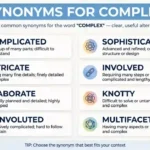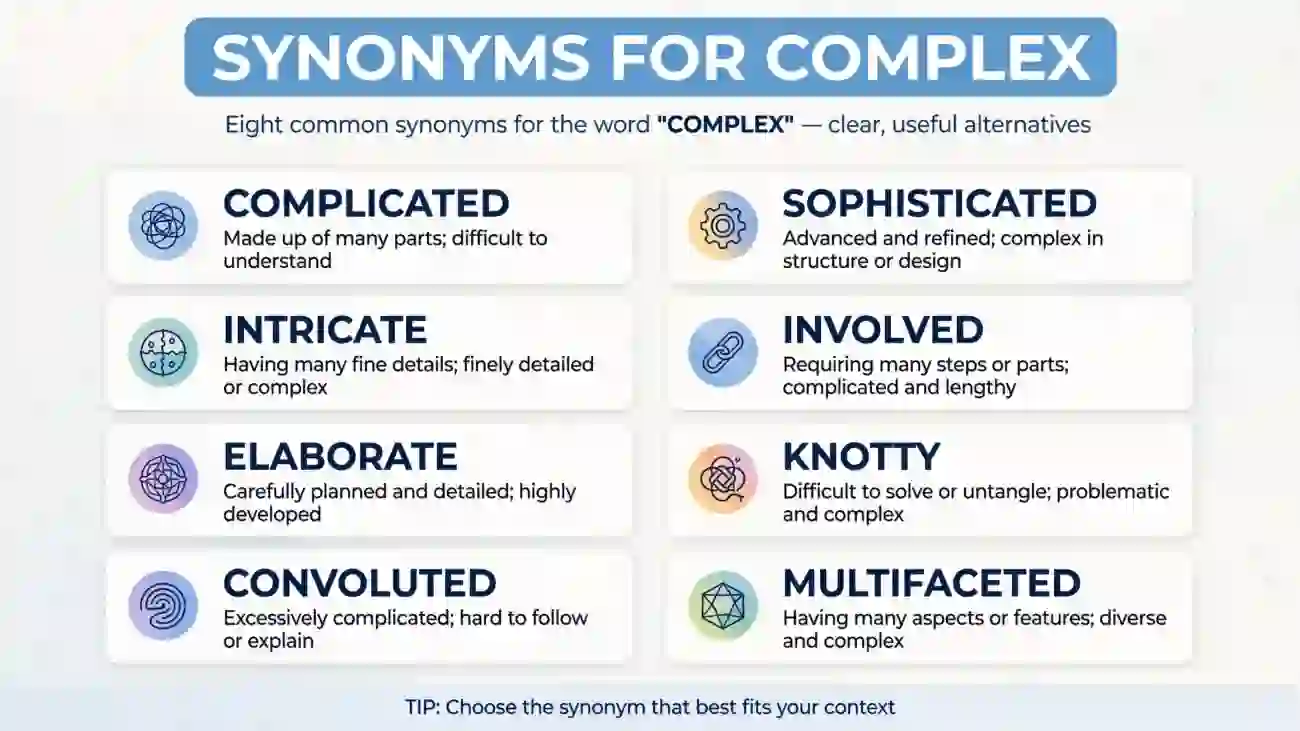
A synonym for complex is complicated, which describes something with many parts or details that are difficult to understand. Other useful synonyms include intricate, elaborate, sophisticated, multifaceted, and convoluted. The best choice depends on the context: use “intricate” for fine details, “sophisticated” for advanced systems, and “complicated” for something difficult to understand.
Key Takeaways
- Complicated is the closest everyday synonym for complex.
- Intricate describes something with many connected or detailed parts.
- Sophisticated suggests advanced design, knowledge, or technology.
- Multifaceted describes something with several different aspects.
- Simple and straightforward are common opposites of complex.
What Is the Best Synonym for Complex?
The best synonym for complex is usually complicated. Both words describe something that has many parts, details, or relationships and may be difficult to understand.
However, the right alternative depends on what you want to describe. A complex computer system might be sophisticated, an intricate design might contain many small details, and a complex issue might be multifaceted.
For example:
- Original: The instructions are complex.
- Everyday alternative: The instructions are complicated.
- Clearer alternative: The instructions are difficult to follow.
- Formal alternative: The procedure involves several interrelated steps.
Each sentence communicates a slightly different idea. Choosing the right word makes your writing clearer and more precise.
25 Synonyms for Complex and Their Meanings
Here are 25 useful alternatives to “complex,” along with their meanings and example sentences.
| Synonym | Meaning | Example |
| Complicated | Difficult to understand or manage | The rules are complicated. |
| Intricate | Made of many detailed parts | The artist created an intricate pattern. |
| Elaborate | Carefully developed with many details | They planned an elaborate celebration. |
| Sophisticated | Advanced or highly developed | The company uses sophisticated software. |
| Multifaceted | Having several different aspects | Poverty is a multifaceted issue. |
| Convoluted | Extremely complicated and hard to follow | The explanation was convoluted. |
| Detailed | Including many specific facts | She provided a detailed report. |
| Difficult | Not easy to understand or complete | The assignment was difficult. |
| Challenging | Requiring effort or skill | Learning a new language can be challenging. |
| Technical | Requiring specialized knowledge | The manual contains technical information. |
| Advanced | Developed beyond a basic level | Students studied advanced mathematics. |
| Nuanced | Containing subtle differences | The article offers a nuanced perspective. |
| Interconnected | Having parts that influence one another | The problems are interconnected. |
| Layered | Having several levels of meaning or structure | The novel has a layered storyline. |
| Dense | Containing much information in a small space | The textbook has dense explanations. |
| Complicated-looking | Appearing difficult or involved | The diagram looks complicated. |
| Knotty | Difficult to solve or understand | The lawyer faced a knotty legal question. |
| Thorny | Difficult and sensitive to deal with | They discussed a thorny policy issue. |
| Intriguing | Interesting because it is unusual or complex | The scientist explored an intriguing theory. |
| Multifactorial | Involving several contributing factors | The condition has a multifactorial cause. |
| Sophisticatedly designed | Designed with advanced features | The device is sophisticatedly designed. |
| Interwoven | Closely connected or combined | The themes are interwoven throughout the book. |
| Involved | Having many parts or steps | The approval process is involved. |
| Comprehensive | Covering many aspects of a subject | The guide provides a comprehensive overview. |
| Subtle | Involving fine or difficult-to-notice distinctions | The argument contains subtle differences. |
Complex vs. Complicated vs. Intricate
The words complex, complicated, and intricate are closely related, but they do not always mean exactly the same thing.
| Word | Main emphasis | Best use |
| Complex | Many connected parts or relationships | Systems, issues, processes |
| Complicated | Difficult to understand or manage | Instructions, rules, situations |
| Intricate | Many small, carefully connected details | Designs, patterns, mechanisms |
| Sophisticated | Advanced development or features | Technology, methods, analysis |
| Convoluted | Unnecessarily difficult to follow | Explanations, arguments, procedures |
| Multifaceted | Several different aspects | Problems, personalities, topics |
Consider these examples:
- Complex: Climate change is a complex global issue.
- The tax instructions confuse taxpayers.
- Intricate: The watch contains an intricate mechanical system.
- Sophisticated: The laboratory uses sophisticated equipment.
- Convoluted: His convoluted explanation confused the audience.
- Multifaceted: The decision involves multifaceted social and economic concerns.
A complex subject is not always difficult simply because it has many parts. Some complex systems become easier to understand when people use the right tools or explanations. Likewise, people may find something complicated because someone organizes its instructions poorly. Choose the word that describes the specific quality you mean.
What Is a Formal Synonym for Complex?
In formal, academic, and professional writing, several alternatives can replace “complex.” The strongest choice depends on the subject and the point you want to make.
Intricate works well when describing detailed structures, relationships, or designs.
Example: “The researchers examined the intricate relationships between the variables.”
Multifaceted is useful when a subject has several dimensions or causes.
Example: “The report examines the multifaceted challenges facing modern education.”
Sophisticated describes advanced methods, systems, or ideas.
Example: “The team developed a sophisticated model to analyze the results.”
Multifactorial is especially useful when multiple factors contribute to an outcome.
Example: “The researchers found that the issue had a multifactorial origin.”
Interconnected emphasizes how different parts influence one another.
Example: “The study explores interconnected economic and environmental concerns.”
For a professional report, avoid choosing a word merely because it sounds impressive. A precise, familiar word usually communicates your point more effectively than an unnecessarily complicated alternative.
What Is a Simple Word for Complex?
If you want a simple word for “complex,” try complicated, hard, difficult, or involved. If your goal is to make a sentence easier to understand, a short phrase may work better than another synonym.
Here are some easy alternatives:
- Hard: The math problem is hard.
- Difficult: The process is difficult to understand.
- Complicated: The instructions are complicated.
- Involved: The application process is involved.
- Not simple: The situation is not simple.
- Has many parts: The machine has many parts.
For example, instead of writing, “The project involves a complex procedure,” you could write, “The project requires several steps.”
This version uses simpler language and explains what makes the procedure complex. That approach is especially helpful when writing for a general audience, younger readers, or people who speak English as a second language.
How to Use Synonyms for Complex in Sentences
The best synonym depends on the noun you are describing. Use these examples to find a natural replacement for “complex” in different situations.
| Context | Original sentence | Better alternative |
| Business | We face a complex challenge. | We face a multifaceted challenge. |
| Technology | The system is complex. | The system is sophisticated. |
| Education | This is a complex topic. | This is a complicated topic. |
| Art | The painting has a complex design. | The painting has an intricate design. |
| Science | The process is complex. | The process involves several interconnected stages. |
| Writing | The explanation is complex. | The explanation is convoluted. |
| Research | The problem is complex. | The problem has several contributing factors. |
| Law | This is a complex legal issue. | This is a complicated legal issue. |
| Everyday life | The situation is complex. | The situation is difficult to manage. |
| Literature | The story has a complex plot. | The story has a layered plot. |
Tips for Choosing the Right Synonym
Before replacing “complex,” ask yourself what you mean.
- If something has many parts, consider it intricate or complicated.
- If it contains several viewpoints, consider multifaceted.
- If it uses advanced technology, consider it sophisticated.
- If it is hard to understand, consider it difficult or convoluted.
- If it includes many facts or details, consider details.
- If several parts affect one another, consider them interconnected.
These distinctions help you choose words that communicate your intended meaning instead of simply repeating a similar term.
What Is the Opposite of Complex?
The most common antonyms of “complex” are simple and straightforward. Other alternatives include easy, uncomplicated, basic, clear, and uncomplicated.
| Antonym | Meaning | Example |
| Simple | Not complicated | The solution is simple. |
| Straightforward | Easy to understand or follow | The instructions are straightforward. |
| Easy | Requiring little effort | The task is easy to complete. |
| Uncomplicated | Free from unnecessary difficulty | We chose an uncomplicated approach. |
| Basic | At an introductory or fundamental level | The course covers basic concepts. |
| Clear | Easy to understand | Her explanation was clear. |
| Plain | Simple and easy to understand | He used plain language. |
The best opposite depends on the sentence. “Simple” is a general opposite, while “straightforward” is particularly useful for instructions, explanations, and processes.
For example:
- Complex: The application process is complex.
- Straightforward: The application process is straightforward.
The second sentence suggests that people can understand and follow the process without much difficulty.
Frequently Asked Questions
What is the closest synonym for complex?
Complicated is usually the closest everyday synonym for complex. Both words describe something with many parts or details that may be difficult to understand. However, “intricate” is often better for detailed designs, while “multifaceted” works well for issues involving several different aspects.
What is a positive synonym for complex?
Sophisticated is a good positive alternative when you want to emphasize advanced design, skill, or development. “Intricate” can also sound positive when describing detailed craftsmanship. For example, “The designer created a sophisticated interface” emphasizes advanced features rather than difficulty.
What is a professional way to say complex?
Professional alternatives include “multifaceted,” “intricate,” “sophisticated,” and “interconnected.” Use “multifaceted” for subjects with several dimensions, “sophisticated” for advanced systems, and “interconnected” when different elements influence one another. The most professional choice is the one that accurately describes the subject.
Can complex mean difficult?
Yes, complex can suggest difficulty, but the two words are not identical. “Complex” usually refers to something with many parts, relationships, or details. “Difficult” emphasizes how much effort or skill something requires. A complex task may become easier when someone understands its structure.
What is a synonym for a complex problem?
Useful synonyms or alternative phrases include “complicated problem,” “multifaceted issue,” “challenging problem,” and “intricate issue.” Use “multifaceted issue” when a problem has several dimensions, and “complicated problem” when it is hard to understand or solve. “Multifactorial problem” works when multiple factors contribute to the outcome.
Conclusion
If you ask, “What is a synonym for complex?” the simplest answer is “complicated.” However, words such as intricate, sophisticated, multifaceted, and interconnected can be more accurate in specific situations.
Think about the meaning you want to communicate, the audience you are writing for, and the context of your sentence. Choosing the right alternative will make your writing clearer, more natural, and more effective.

I am Johnny Lee is a passionate writer and language enthusiast dedicated to making English grammar simple, practical, and easy to understand. Through grameases.com, he helps learners improve their English skills with clear explanations.