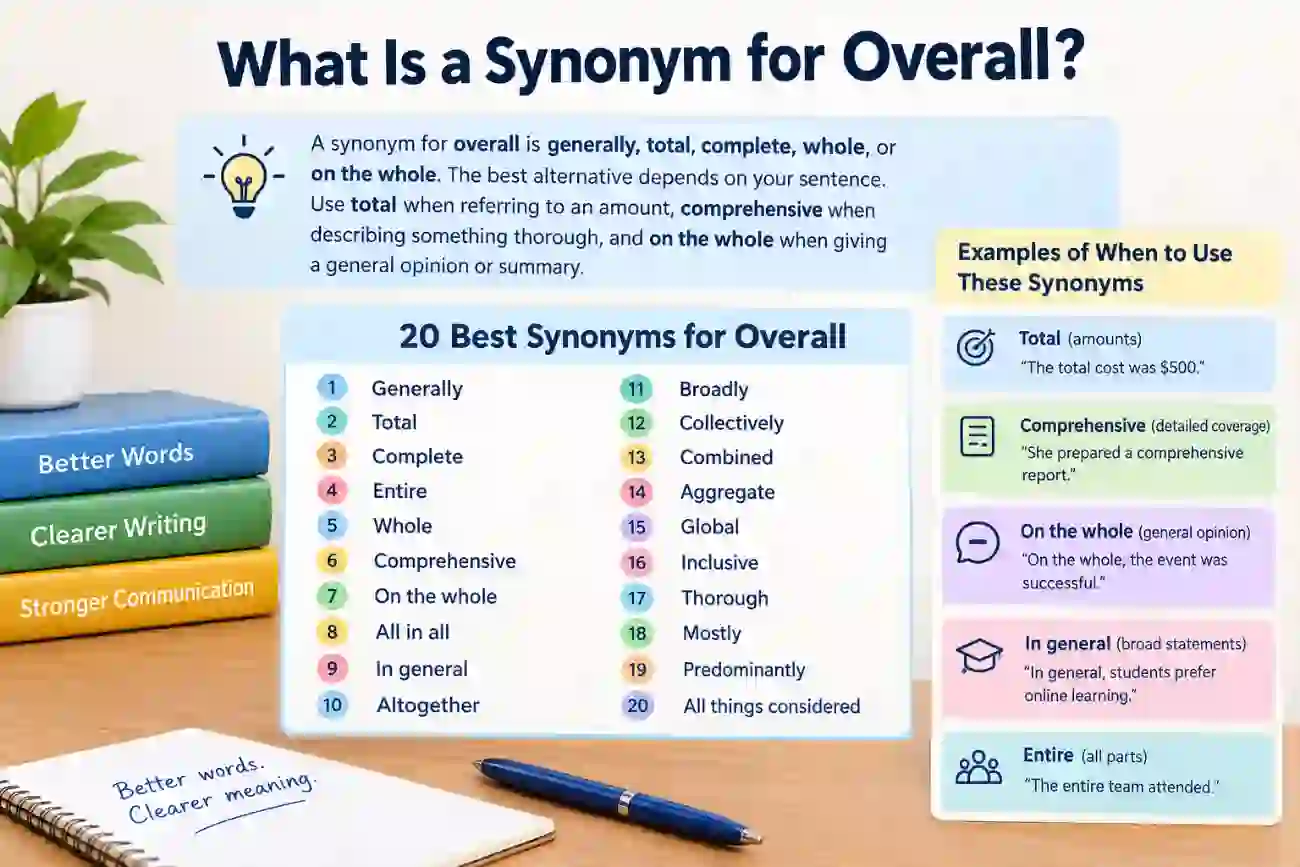
A synonym for overall is generally, total, complete, whole, or on the whole. The best alternative depends on your sentence.
Use total when referring to an amount, comprehensive when describing something thorough, and on the whole when giving a general opinion or summary.
Key Takeaways
- Generally and on the whole work well when discussing a situation broadly.
- Total, entire, and complete describe something as a whole.
- Comprehensive is useful for detailed reports, plans, and reviews.
- All in all and all things considered help summarize an opinion.
- Choose a synonym based on your sentence’s meaning, not just to avoid repeating a word.
What Does Overall Mean?
The word overall means considering something as a whole rather than focusing on individual parts. It can also describe the complete amount, effect, size, or condition of something.
According to the Cambridge Dictionary, overall can function as both an adjective and an adverb. Its meaning changes slightly depending on how you use it.
English meaning – Cambridge Dictionary
+1
For example:
- As an adjective: The overall cost of the project was reasonable.
- As an adverb: Overall, the presentation went well.
In the first sentence, overall describes the total cost. In the second, it gives a general judgment about the presentation.
Understanding this difference helps you choose a replacement that fits your sentence naturally.
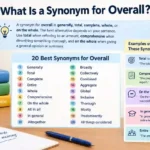
20 Best Synonyms for Overall
Here are 20 useful alternatives, along with their meanings and example sentences.
| Synonym | Best use | Example |
|---|---|---|
| Generally | Broad statements | Generally, the feedback was positive. |
| Total | Complete amounts | The total expense was $500. |
| Complete | Nothing missing | We received a complete report. |
| Entire | Something as a whole | The entire team attended. |
| Whole | All parts together | The whole process took an hour. |
| Comprehensive | Detailed coverage | She prepared a comprehensive guide. |
| On the whole | General opinions | On the whole, the event was successful. |
| All in all | Summaries and opinions | All in all, it was a great day. |
| In general | Broad observations | In general, customers prefer simple designs. |
| Altogether | Taken as a whole | Altogether, the changes improved the service. |
| Broadly | Wide or general scope | Broadly, the plan addresses our needs. |
| Collectively | Groups or combined efforts | Collectively, the team solved the problem. |
| Combined | Multiple things together | The combined results were encouraging. |
| Aggregate | Data and totals | The aggregate score increased. |
| Global | Whole systems or worldwide scope | The report examines global demand. |
| Inclusive | All relevant items or people | The inclusive price covers all fees. |
| Thorough | Careful, detailed work | The team completed a thorough review. |
| Mostly | Most, but not all | The audience was mostly satisfied. |
| Predominantly | Mainly or chiefly | The area is predominantly residential. |
| All things considered | Balanced final judgment | All things considered, we made the right choice. |
These alternatives reflect established dictionary usage, but they are not interchangeable in every sentence.
Collins English Thesaurus
+2
Synonyms That Mean the Whole or Total
Use these words when overall describes the full amount, size, scope, or condition of something.
- Total: Best for numbers, expenses, quantities, and final amounts.
- Entire: Emphasizes every part of something.
- Complete: Suggests that all necessary parts are present.
- Whole: Refers to something considered as one complete unit.
- Comprehensive: Describes something that covers all or most important aspects.
- Aggregate: Refers to a combined total, especially in statistics, business, and data analysis.
- Global: Works for worldwide matters or broad systems, depending on context.
Example:
Original: The overall cost of the renovation was high.
Better alternatives:
- The total cost of the renovation was high.
- The complete budget included several unexpected expenses.
- The aggregate expenses exceeded our original estimate.
Notice that the first alternative is the closest match. The other two change the sentence’s focus slightly.
Synonyms That Mean Generally or All Things Considered
Use these alternatives when you want to express an opinion, summarize an experience, or describe a situation without discussing every detail.
- Generally: Suitable for broad observations.
- In general: A clear, everyday alternative.
- On the whole: Useful for balanced opinions.
- All in all: Friendly and conversational.
- All things considered: Highlights a judgment made after weighing different factors.
- Altogether: Can mean completely or when everything is considered.
- Mostly: Best when something is true in most cases, but not necessarily all of them.
Example:
Original: Overall, I enjoyed the movie.
Possible rewrites:
- Generally, I enjoyed the movie.
- On the whole, I enjoyed the movie.
- All in all, I enjoyed the movie.
- All things considered, I enjoyed the movie.
The last three often sound more natural when expressing a final opinion.
Which Synonym for Overall Should You Use?
The right synonym depends on what you want to communicate. Before replacing overall, decide whether your sentence refers to a total amount, a broad description, or a final judgment.
| Your writing purpose | Best synonym | Why it works |
|---|---|---|
| Academic essay | In general | Introduces a broad observation |
| Business report | Comprehensive | Highlights detailed coverage |
| Financial calculation | Total | Clearly describes an amount |
| General opinion | On the whole | Presents a balanced view |
| Casual conversation | All in all | Sounds natural and friendly |
| Statistical analysis | Aggregate | Describes combined data |
| Formal conclusion | All things considered | Shows that several factors were weighed |
| Describing every part | Entire | Emphasizes the complete thing |
| Describing a broad trend | Generally | Avoids focusing on exceptions |
| Describing most cases | Mostly | Allows for some exceptions |
For Professional and Business Writing
In workplace communication, choose precise words that explain exactly what you mean.
Instead of writing, “The overall performance improved,” consider:
- “The general performance improved.” This emphasizes performance broadly.
- “The total output increased.” This focuses on the amount produced.
- “The overall assessment was positive.” This is already natural if you mean a broad evaluation.
- “The comprehensive review identified three opportunities.” This highlights the scope of the review.
Do not replace overall automatically. Sometimes the original word is the clearest choice.
For Academic Writing
Academic writing benefits from precise language and clear connections between ideas.
You can use in general, broadly, taken together, or on balance when they fit your argument.
For example:
Original: Overall, the evidence supports the main argument.
Rewritten: Taken together, the evidence supports the main argument.
The revised version emphasizes the combined weight of the evidence rather than making a general statement.
For Everyday Conversations
Simple expressions often sound more natural than formal alternatives.
For example:
- “Overall, we had a good weekend.”
- “All in all, we had a good weekend.”
- “On the whole, we had a good weekend.”
All three are understandable, although all in all may sound more conversational.
Examples of Overall and Its Synonyms in Sentences
Seeing synonyms in context makes it easier to understand when each word works best.
1. Overall Performance
Original: The overall performance of the team was impressive.
Alternative: The team’s general performance was impressive.
Another option: On the whole, the team performed impressively.
Use the adjective general when describing performance broadly. Use the phrase on the whole when presenting a judgment.
2. Overall Cost
Original: The overall cost of the trip was $1,200.
Alternative: The total cost of the trip was $1,200.
Here, total is more precise because the sentence refers to a specific amount of money.
3. Overall Experience
Original: My overall experience with the service was positive.
Alternative: On the whole, my experience with the service was positive.
Another option: All in all, I had a positive experience with the service.
These alternatives work because the sentence expresses an opinion about an experience.
4. Overall Plan
Original: We need an overall strategy for the project.
Alternative: We need a comprehensive strategy for the project.
The revised sentence suggests that the strategy should address the project’s important parts. If you simply mean a broad direction, general strategy may be more suitable.
5. Overall Results
Original: The overall results were better than expected.
Alternative: The combined results were better than expected.
Another option: Taken together, the results were better than expected.
Choose combined when emphasizing multiple results considered together. Use taken together when drawing a conclusion from several pieces of evidence.
6. Overall Opinion
Original: Overall, I think the proposal is worth considering.
Alternative: All things considered, I think the proposal is worth considering.
This wording suggests that you have weighed the advantages and disadvantages before forming your opinion.
What Can You Say Instead of Overall in an Essay?
If you use overall several times in an essay, try replacing it with a phrase that matches the purpose of each sentence. You can also remove the word entirely if the sentence remains clear.
Here are five practical examples.
Example 1: Introducing a general point
Before: Overall, students benefit from regular reading.
After: In general, students benefit from regular reading.
Example 2: Summarizing evidence
Before: Overall, the findings support the hypothesis.
After: Taken together, the findings support the hypothesis.
Example 3: Giving a balanced judgment
Before: Overall, the policy has more benefits than drawbacks.
After: On balance, the policy has more benefits than drawbacks.
Example 4: Describing complete coverage
Before: The overall report covers three major topics.
After: The comprehensive report covers three major topics.
Example 5: Ending a discussion
Before: Overall, these factors explain the change.
After: These factors explain the change.
The fifth example shows an important editing principle: you do not always need a synonym. Removing an unnecessary word can make your writing clearer and more direct.
For an essay’s final paragraph, phrases such as in conclusion, to summarize, and taken together may also work. However, they serve different purposes. In conclusion signals the end of an argument, while taken together connects evidence or ideas.
Common Mistakes When Replacing Overall
Choosing a synonym is not just about finding a similar word. You must preserve the meaning of the original sentence.
1. Using Total When You Mean Generally
Incorrect: Total, the meeting went well.
Better: Generally, the meeting went well.
Total usually describes an amount or something complete. It does not naturally introduce a general opinion.
2. Confusing Mostly With Entirely
These words have different meanings. Mostly means for the most part, while entirely means completely.
For example:
- Mostly: The report was mostly accurate, but it contained two errors.
- Entirely: The report was entirely accurate.
Replacing one with the other can change your sentence’s meaning.
3. Using Comprehensive for Every Situation
Comprehensive means covering a broad range of relevant subjects or details. It does not always work as a replacement for overall.
For example, “the overall cost” is natural, but “the comprehensive cost” usually sounds incorrect. Use “the total cost” instead.
4. Adding Unnecessary Formal Words
A long phrase is not automatically better than a short word.
For example, “All things considered, the plan worked” is appropriate when weighing several factors. If you are simply giving a quick opinion, “Overall, the plan worked” is shorter and clearer.
Choose natural language over complicated vocabulary.
Frequently Asked Questions
What is the closest synonym for overall?
The closest synonym depends on the sentence. Generally and on the whole are strong alternatives when discussing a situation broadly. Total, whole, and complete are closer when overall describes an amount or something that includes all its parts.
What is a formal word for overall?
Comprehensive is a useful formal alternative when describing something that covers many relevant details. Aggregate works in statistical or financial contexts, while total is appropriate for amounts. For general conclusions, on balance can be suitable in formal writing.
Is generally a synonym for overall?
Yes, generally can replace overall when both words mean considering a situation broadly. For example, “Overall, the results were positive” can become “Generally, the results were positive.” However, generally can also mean usually, so check that the intended meaning remains clear.
What is another way to say overall conclusion?
You can say final assessment, general conclusion, summary, or concluding judgment, depending on your sentence. For example, “Our overall conclusion is that the plan worked” could become “Our final assessment is that the plan worked.” You can also use “In conclusion” to introduce a concluding paragraph.
Can I use altogether instead of overall?
Sometimes. Altogether can mean completely or when everything is considered. For example, “Altogether, the changes improved the experience” is natural. However, you would not normally say “the altogether cost” instead of “the overall cost.” Use total cost in that sentence.
Conclusion
The best answer to “what is a synonym for overall” depends on the context. Generally, on the whole, total, complete, entire, and comprehensive are useful alternatives, but each has a different purpose.
Use total for amounts, comprehensive for broad coverage, and on the whole for general opinions. In essays and professional writing, you can also improve clarity by removing overall when it adds no meaning.
The goal is not to replace every repeated word. It is to choose the clearest expression for your message.

I am Johnny Lee is a passionate writer and language enthusiast dedicated to making English grammar simple, practical, and easy to understand. Through grameases.com, he helps learners improve their English skills with clear explanations.