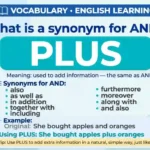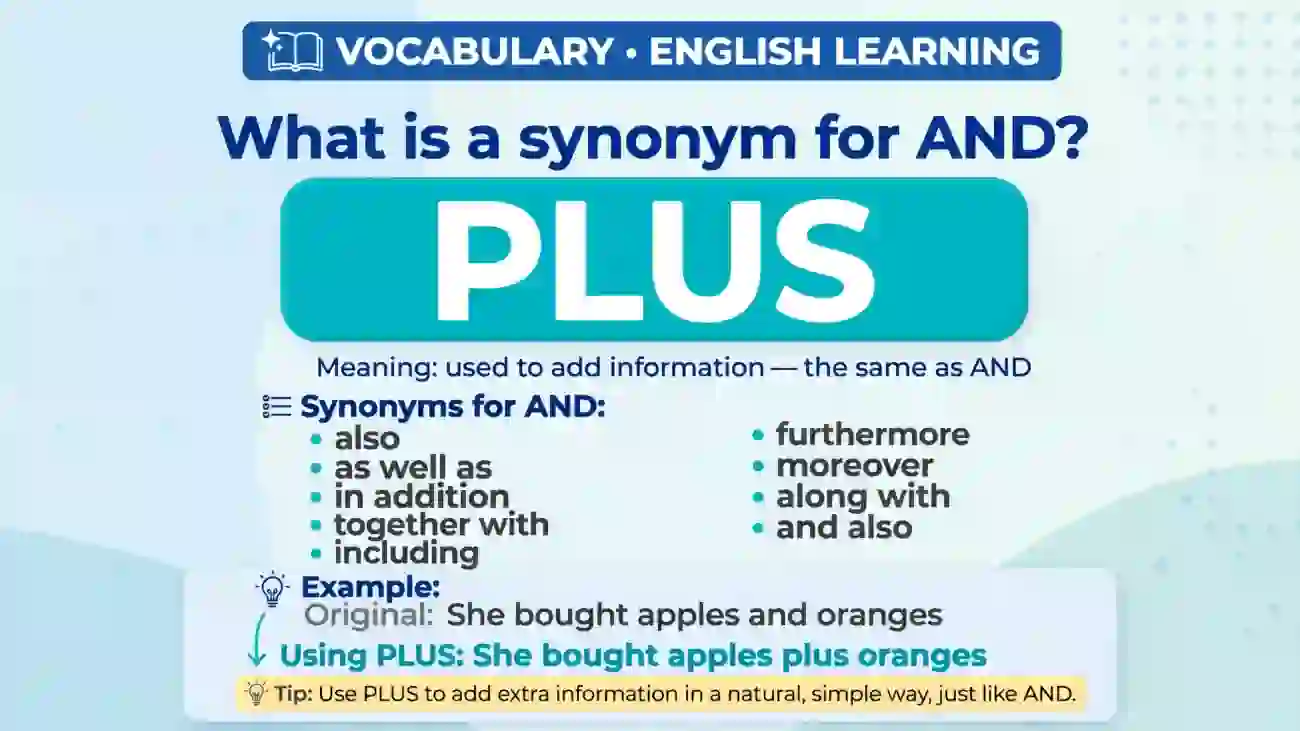
A synonym for “and” can be “also,” “plus,” “as well as,” “along with,” or “in addition to,” depending on the sentence.
For formal writing, “moreover” and “furthermore” can introduce additional information. However, these words are not always interchangeable, so choose an alternative that preserves your original meaning.
Key Takeaways
- Also, plus, and as well as are useful alternatives when adding information.
- Moreover, furthermore, and in addition work well when introducing another point in formal writing.
- Along with, together with, and coupled with connect related people, things, or ideas.
- Some alternatives change sentence structure, so check grammar before replacing “and.”
- Repeating “and” is not automatically a mistake. Sometimes it is the clearest choice.
What Does the Word “And” Mean?
“And” is a coordinating conjunction that connects words, phrases, or clauses of equal grammatical importance. It usually shows that two or more things belong together or that one idea is being added to another.
Cambridge Dictionary
+1
For example:
- Two nouns: I bought apples and oranges.
- Two adjectives: The room was clean and comfortable.
- Two actions: She opened the book and started reading.
- Two complete ideas: He finished his work, and he went home.
The best alternative depends on what “and” connects. A word that works between two nouns may not work between two complete sentences.
For example, “I like tea and coffee” can become “I like tea as well as coffee.” However, replacing “and” with “moreover” would sound unnatural in that sentence.
Understanding the purpose of the original word helps you choose a natural replacement.
15 Useful Synonyms and Alternatives for And
Here are 15 options you can use to connect ideas, reduce repetition, or make your writing more precise.
Alternatives for Adding Information
1
Also
Use “also” to introduce an additional fact or action.
Example: She writes articles and also edits books.
2
Plus
A casual alternative that adds another item or point.
Example: The hotel is affordable, plus it offers free breakfast.
3
As well as
Connects related things or activities.
Example: He enjoys reading as well as writing.
4
Too
Usually appears at the end of a sentence or clause to mean “also.”
Example: Maya wants to join the trip, and I do too.
5
In addition
Introduces another related point, especially in written English.
Example: The course is affordable. In addition, it offers personal feedback.
These alternatives are useful when you want to show that another item, action, or point belongs in the discussion. Their grammar and placement differ, so they should not be swapped mechanically.
Cambridge Dictionary
+2
Alternatives for Formal and Academic Writing
6
Moreover
Adds a supporting point to an argument.
Example: The proposal saves money. Moreover, it reduces waste.
7
Furthermore
Introduces another point in a formal explanation or argument.
Example: The study identified several risks. Furthermore, it suggested practical solutions.
8
Additionally
Adds another fact, detail, or consideration.
Example: The software is easy to use. Additionally, it works on mobile devices.
9
In addition to
Introduces an extra person, thing, or activity.
Example: In addition to teaching, she writes educational guides.
10
Not only … but also
Emphasizes two qualities, facts, or actions together.
Example: The course is not only affordable but also practical.
For essays, reports, and professional documents, “moreover,” “furthermore,” and “additionally” can introduce another complete point. They are transition words, not direct replacements for “and” between every pair of words.
Cambridge Dictionary
+2
Alternatives for Connecting Related Ideas
11
Along with
Shows that something accompanies or is included with something else.
Example: She brought her laptop along with her notebook.
12
Together with
Highlights items or people considered as a group.
Example: The manager, together with her team, reviewed the plan.
13
Combined with
Shows how two things work or are considered together.
Example: Regular exercise, combined with healthy eating, supports overall well-being.
14
Coupled with
Connects two related factors, often in formal or analytical writing.
Example: Strong demand, coupled with limited supply, pushed prices higher.
15
Plus also / and also
Use “and also” when you want to emphasize an extra action or fact, but avoid “plus also” in most edited writing because it is often redundant.
Example: The guide explains grammar and also provides practice exercises.
Remember that phrases such as “along with” and “coupled with” express relationships between items. They may require a different sentence structure from the original sentence using “and.”
Synonyms for And With Examples
The following table compares common alternatives and shows when each one works best.
| Alternative | Best use | Example |
|---|---|---|
| Also | Adding information | She teaches and also writes. |
| Plus | Casual addition | It’s cheap, plus it’s reliable. |
| As well as | Connecting related items | He sings as well as dances. |
| Too | Adding agreement or inclusion | I want to come too. |
| Moreover | Supporting an argument | The plan is simple. Moreover, it’s affordable. |
| Furthermore | Adding a formal point | The test was easy. Furthermore, it was quick. |
| Additionally | Introducing another detail | Additionally, the service is free. |
| In addition to | Adding an item or activity | In addition to math, she studies science. |
| Along with | Showing association | Bring your ID along with your ticket. |
| Together with | Grouping people or things | Sam, together with Lee, prepared dinner. |
| Combined with | Showing a combination | Skill combined with practice improves performance. |
| Coupled with | Connecting related factors | Experience, coupled with training, builds confidence. |
Important: “Moreover,” “furthermore,” and “additionally” usually introduce another point, while “and” can directly connect words and phrases. They have related purposes but are not interchangeable in every grammatical structure.
Cambridge Dictionary
+1
How to Choose the Right Alternative to And
Choose a replacement based on your meaning, audience, and sentence structure.
1. For everyday conversations
Use simple expressions such as “also,” “too,” or “plus.”
- Original: I bought bread and milk.
- Alternative: I bought bread, plus some milk.
The second sentence sounds more conversational. The original is still perfectly correct.
2. For school essays and academic writing
Choose “moreover,” “furthermore,” “additionally,” or “in addition” when introducing a separate supporting point.
- Original: The program saves time and reduces costs.
- Alternative: The program saves time. Furthermore, it reduces costs.
The revised version gives each point more emphasis. However, if both ideas belong naturally in one sentence, “and” may be clearer.
3. For business and professional writing
Use “in addition to,” “along with,” or “as well as” when these phrases fit the intended meaning.
- Original: The employee manages sales and customer support.
- Alternative: The employee manages sales as well as customer support.
Both versions are natural. The alternative changes the emphasis slightly but keeps the main message.
4. To improve sentence flow
Read the paragraph aloud. If several sentences use “and” repeatedly, consider whether some ideas deserve separate sentences or a different transition.
For example:
Before: The team planned the event and booked the venue and invited the guests and arranged the food.
After: The team planned the event, booked the venue, and invited the guests. It also arranged the food.
The revised version is easier to follow because it groups related actions and gives the reader a natural pause.
Common Mistakes When Replacing And
Finding another word for “and” is useful, but the wrong substitution can make your writing less clear.
Mistake 1: Using “moreover” between two nouns
Incorrect: I bought apples moreover oranges.
Correct: I bought apples and oranges.
You could write “I bought apples. Moreover, I bought oranges,” but that sounds unnecessarily formal for a simple shopping list.
Mistake 2: Using “as well as” without checking the verb
Incorrect: She enjoys reading as well as to write.
Correct: She enjoys reading as well as writing.
When “as well as” connects activities in this structure, the verbs generally use matching forms. Cambridge’s grammar guidance also explains how “as well as” and “in addition to” work with -ing clauses.
Cambridge Dictionary
+1
Mistake 3: Assuming “also” always replaces “and”
Incorrect: He also his brother went to school.
Correct: He and his brother went to school.
You can write “He also went to school,” but that sentence has a different structure and does not connect two people as the subject.
Mistake 4: Adding transitions that do not fit the relationship
“And” usually adds or connects information. “However” signals contrast, while “therefore” signals a result. Choose a transition based on the actual relationship between the ideas, not simply because you want to avoid repetition.
Mistake 5: Replacing every occurrence
There is nothing wrong with using “and” several times when it makes a sentence easy to understand. Clear writing is more important than variety for its own sake.
Frequently Asked Questions
What is another word for and?
Common alternatives include “also,” “plus,” “as well as,” “along with,” and “in addition to.” For formal writing, “moreover,” “furthermore,” and “additionally” can introduce extra information. The right choice depends on whether you are connecting words, adding a detail, or introducing a separate point.
What is a formal synonym for and?
“Moreover,” “furthermore,” “additionally,” and “in addition” are useful formal transitions. For example, “The report identifies several problems. Furthermore, it recommends practical solutions.” These expressions work best when introducing another idea, rather than directly connecting two nouns or verbs.
Can you start a sentence with and?
Yes. Starting a sentence with “and” is acceptable when it connects the sentence to a previous thought or adds emphasis. For example: “The team finished the project. And everyone celebrated.” Use this structure intentionally, especially in formal writing, where a smoother sentence may be preferable.
Cambridge Dictionary
Is “as well as” the same as “and”?
Not exactly. Both can connect related items, but “as well as” can place more emphasis on the first item or introduce additional information in a different grammatical structure. For example, “She teaches math and science” is straightforward, while “She teaches math as well as science” gives a slightly different emphasis.
How can I avoid using and too often?
Combine short sentences when the ideas belong together, use suitable transitions when introducing a new point, and remove unnecessary connections. For example, instead of writing “He opened the door and entered the room and sat down,” write “He opened the door, entered the room, and sat down.” You do not need a different synonym for every occurrence.
Conclusion
If you are wondering what is a synonym for and, start with the purpose of your sentence.
“Also,” “plus,” and “as well as” work well for adding information, while “moreover,” “furthermore,” and “additionally” help introduce supporting points in formal writing.
For connecting related people or things, consider “along with” or “together with.” Most importantly, do not replace “and” simply to make your writing sound complicated.
Choose the clearest expression that preserves your meaning and keeps your sentence grammatically correct.

I am Harper L. James is a writer at Grameases.com, focusing on English grammar, similes, metaphors, and simple explanations that make learning English easy and practical.