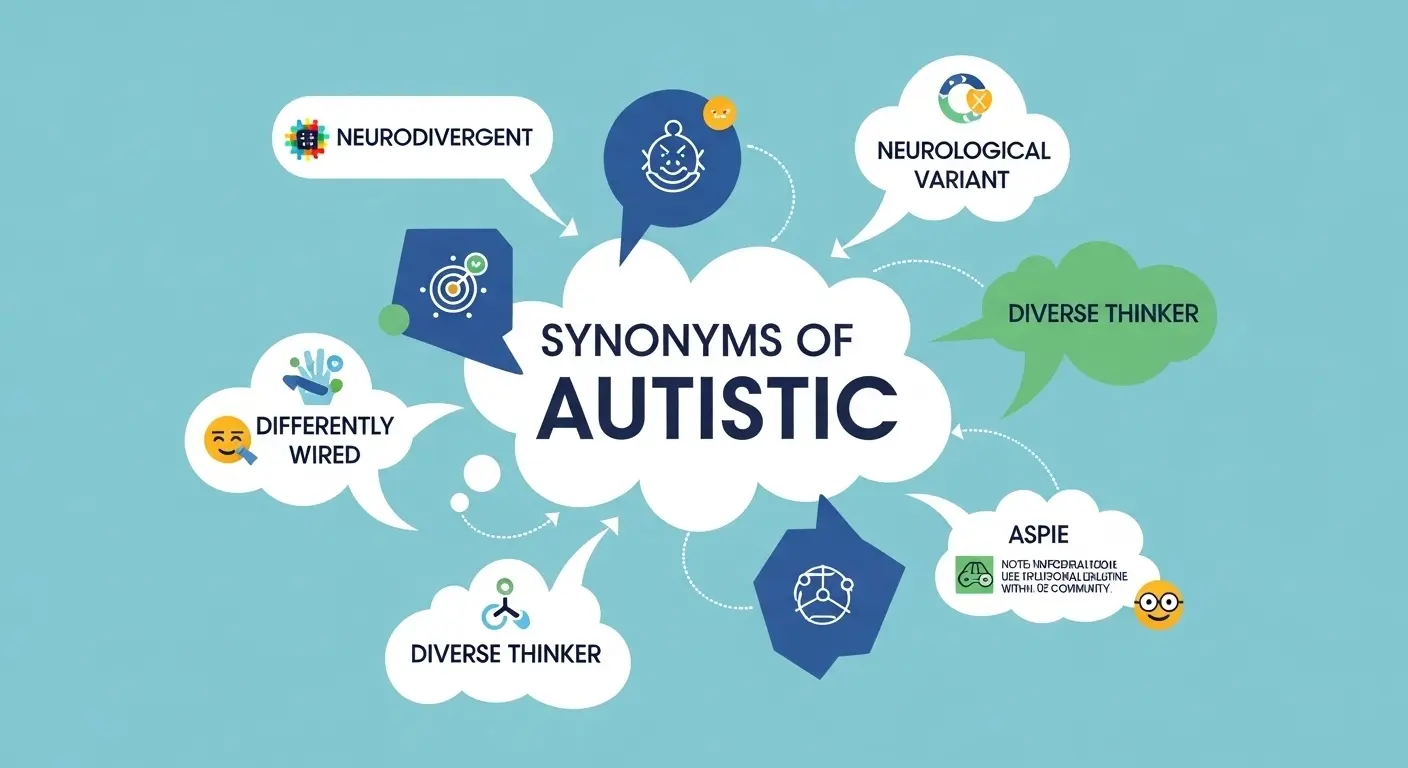
Have you ever searched for the right word but felt unsure which one is respectful and correct? Many people look for synonyms of autistic because they want to describe behavior, personality, or communication style more clearly. But this topic needs care.
For example, a teacher once described a quiet child as “autistic” just because he liked to sit alone and focus deeply. Later, she learned that being quiet does not mean someone is autistic. Words matter. They shape how we see people.
In simple English: Autistic means a person who has autism a brain difference that affects communication, behavior, and social interaction.
Learning accurate and respectful vocabulary helps students, bloggers, teachers, and writers communicate better. It also prevents misunderstandings and stigma.
1. Autism Spectrum Disorder (ASD)
Meaning: The medical term for autism.
Examples:
- She was diagnosed with Autism Spectrum Disorder (ASD) at age five.
- Many schools now provide support for children with ASD.
2. On the Autism Spectrum
Meaning: A person who has autism in any form.
Examples:
- He is on the autism spectrum and loves mathematics.
- Many adults discover later in life that they are on the spectrum.
3. Neurodivergent
Meaning: Someone whose brain works differently from typical patterns.
Examples:
- She identifies as neurodivergent.
- Neurodivergent students may learn in unique ways.
4. Neurodiverse
Meaning: Having a brain that functions differently from the majority.
Examples:
- The company supports neurodiverse employees.
- Neurodiverse thinkers often bring creative ideas.
5. Aspie (Informal)
Meaning: Informal term for someone with Asperger’s syndrome (use carefully).
Examples:
- He calls himself an Aspie.
- Some people like the word Aspie, others do not.
6. Person with Autism
Meaning: Person-first respectful phrase.
Examples:
- She is a person with autism.
- Services are designed for people with autism.
7. Autistic Person
Meaning: Identity-first phrase used by many in the community.
Examples:
- He proudly says he is an autistic person.
- Many autistic people prefer identity-first language.
8. High-Functioning (Outdated/Controversial)
Meaning: Used to describe someone who needs less daily support.
Examples:
- The term high-functioning is now debated.
- Labels like this can oversimplify needs.
9. Low-Functioning (Outdated/Controversial)
Meaning: Used for someone needing more support.
Examples:
- Experts avoid the term low-functioning.
- Support needs vary by situation.
10. Developmentally Different
Meaning: Developing in a different way.
Examples:
- He is developmentally different.
- Every child grows at their own pace.
11. Socially Reserved
Meaning: Prefers less social interaction.
Examples:
- She is socially reserved.
- Being socially reserved does not mean unfriendly.
12. Introverted
Meaning: Gains energy from being alone.
Examples:
- He is introverted and enjoys reading.
- Introverted people like quiet spaces.
13. Detail-Oriented
Meaning: Pays close attention to small details.
Examples:
- She is detail-oriented in her work.
- Detail-oriented thinking helps in coding.
14. Highly Focused
Meaning: Concentrates deeply on one task.
Examples:
- He is highly focused on science.
- She becomes highly focused while drawing.
15. Sensitive to Stimuli
Meaning: Strong reaction to sound, light, or touch.
Examples:
- She is sensitive to loud noises.
- Many autistic individuals are sensitive to stimuli.
16. Literal Thinker
Meaning: Understands words exactly as said.
Examples:
- He is a literal thinker.
- Jokes can confuse literal thinkers.
17. Structured Thinker
Meaning: Likes clear rules and order.
Examples:
- She is a structured thinker.
- Structured thinkers enjoy routines.
18. Routine-Oriented
Meaning: Prefers fixed daily routines.
Examples:
- He is routine-oriented.
- Routine brings comfort.
19. Spectrum Individual
Meaning: Person on the autism spectrum.
Examples:
- She is a spectrum individual.
- Spectrum individuals have diverse strengths.
20. Cognitive Difference
Meaning: Brain processes information differently.
Examples:
- Autism is a cognitive difference.
- Cognitive differences are natural variations.
21. Social Communication Difference
Meaning: Communicates in a different way.
Examples:
- He has a social communication difference.
- Some people need direct instructions.
22. Sensory-Sensitive
Meaning: Easily affected by sensory input.
Examples:
- She is sensory-sensitive.
- Bright lights can overwhelm sensory-sensitive people.
23. Special Interest-Oriented
Meaning: Strong focus on specific topics.
Examples:
- He is special interest-oriented.
- Her special interest is astronomy.
24. Analytical Thinker
Meaning: Think logically and carefully.
Examples:
- She is an analytical thinker.
- Analytical thinkers enjoy patterns.
25. Independent Thinker
Meaning: Think in unique ways.
Examples:
- He is an independent thinker.
- Independent thinkers solve problems creatively.
26. Unique Learner
Meaning: Learn differently.
Examples:
- She is a unique learner.
- Teachers support unique learners with flexible methods.
27. Different Communication Style
Meaning: Talks and expresses differently.
Examples:
- He has a different communication style.
- Understanding different styles builds respect.
28. Neurodevelopmental Condition
Meaning: Brain develops differently from early life.
Examples:
- Autism is a neurodevelopmental condition.
- Early support improves outcomes.
29. Autism Community Member
Meaning: Part of the autism community.
Examples:
- She is an autism community member.
- Community support matters.
30. Neuro-Unique
Meaning: Brain works in a special way.
Examples:
- He is neuro-unique.
- Every neuro-unique person has strengths.
Important Note About Language
When discussing synonyms of autistic, remember:
Autism is not a personality flaw. It is not just shyness or introversion. It is a neurological difference.
Always use respectful, accurate language. When unsure, ask the person how they prefer to be described.
Conclusion
Learning related terms and respectful language improves your writing and communication. If you are a student, blogger, teacher, or content creator, understanding accurate vocabulary helps you avoid mistakes and build trust. Use these terms carefully in essays, articles, and discussions. Practice writing sentences with them. Always choose words that show respect and clarity. Clear language builds understanding. And understanding builds inclusion.

I am Johnny Lee is a passionate writer and language enthusiast dedicated to making English grammar simple, practical, and easy to understand. Through grameases.com, he helps learners improve their English skills with clear explanations.