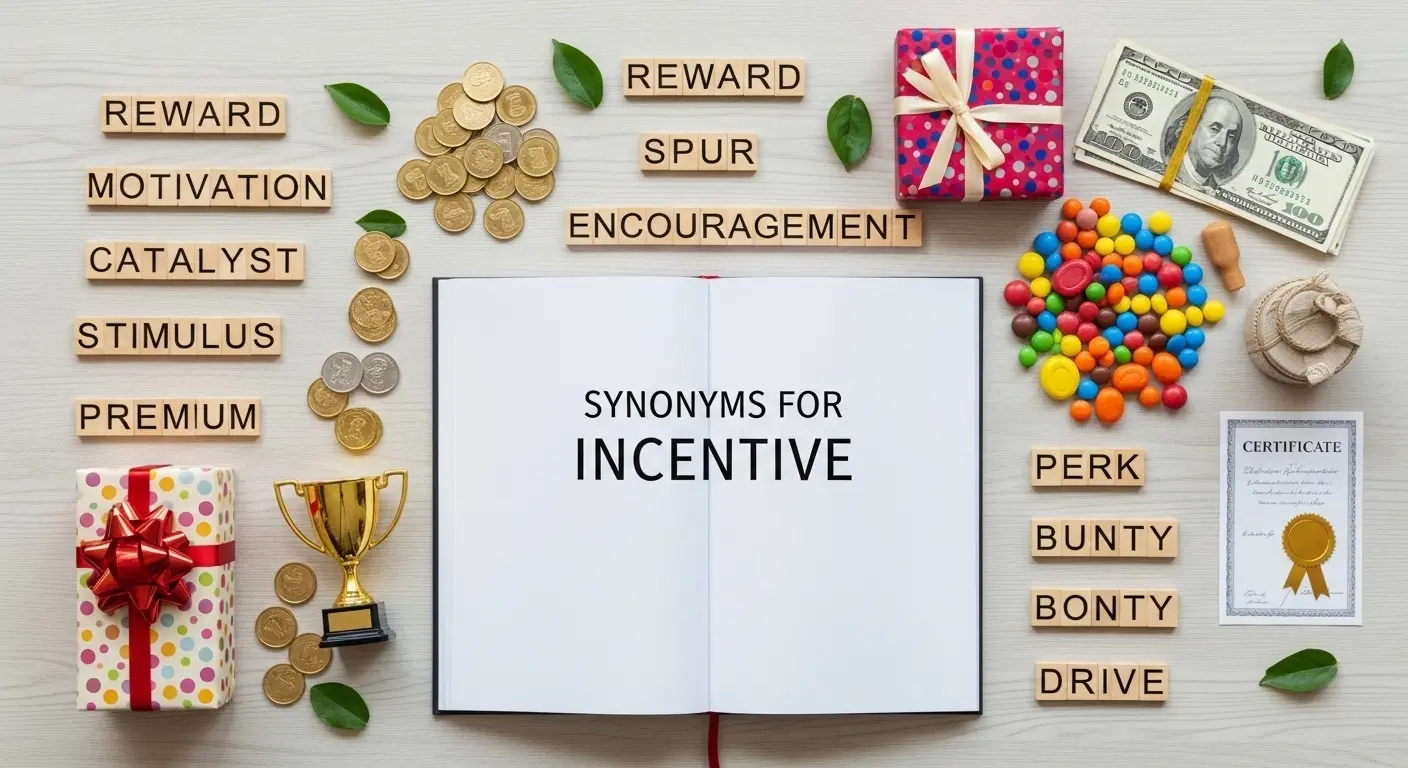
Have you ever felt extra motivated to finish a task because someone promised a reward? Maybe your teacher gave points for completing homework on time, or your boss offered a bonus for meeting a target. That feeling of being motivated to act is exactly what an incentive is.
Being punctual arriving on time is similar. Imagine a student who always comes to class early. They feel confident, respected, and ready to learn. Simply put, punctual means “arriving on time” or “not late.”
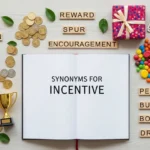
Knowing synonyms for words like incentive is very useful. Students, bloggers, content writers, and everyday English users can make their writing more interesting, professional, and clear. It helps you avoid repetition and express ideas in fresh ways.
1. Motivation
Meaning: Something that makes you want to do something.
Examples:
- She had the motivation to study harder after getting a reward.
- A kind word from a friend can be a strong motivation.
2. Encouragement
Meaning: Support that makes you try harder.
Examples:
- The teacher’s praise gave him encouragement to continue.
- Parents often provide encouragement for children to pursue hobbies.
3. Stimulus
Meaning: Something that makes you react or act.
Examples:
- A new job offer acted as a stimulus to improve her skills.
- Bright colors can act as a stimulus for creativity.
4. Spur
Meaning: A push to do something quickly or better.
Examples:
- His coach’s words were a spur to run faster.
- Deadlines often serve as a spur for completing work.
5. Inducement
Meaning: A reward or offer to make someone do something.
Examples:
- The company gave a cash inducement to attract new employees.
- Free samples are a common inducement in marketing.
6. Reward
Meaning: Something you get for doing well.
Examples:
- He received a reward for his honesty.
- Completing the project on time earned her a reward.
7. Persuasion
Meaning: The act of convincing someone to act.
Examples:
- Her friend’s persuasion made her join the club.
- Advertising uses persuasion to encourage purchases.
8. Benefit
Meaning: Something good that happens from an action.
Examples:
- Studying daily gives the benefit of better grades.
- Health insurance provides a benefit for emergencies.
9. Advantage
Meaning: A condition that helps you succeed.
Examples:
- Being bilingual is a big advantage in jobs.
- Early preparation gave her an advantage in the test.
10. Bonus
Meaning: Extra reward for doing well.
Examples:
- Employees got a year-end bonus for hard work.
- Completing all assignments early earned a bonus.
11. Lure
Meaning: Something attractive that draws you in.
Examples:
- The sale was a lure for shoppers.
- Fame can be a strong lure for actors.
12. Prompt
Meaning: A signal to act quickly.
Examples:
- A reminder email was the prompt to submit the report.
- The teacher’s question acted as a prompt to answer.
13. Drive
Meaning: Inner energy to achieve something.
Examples:
- Her drive to succeed inspired the team.
- Passion gives you a strong drive to improve.
14. Appeal
Meaning: Something that attracts interest or action.
Examples:
- The charity’s story had a strong appeal.
- Bright packaging has an appeal to children.
15. Impulse
Meaning: A sudden urge to act.
Examples:
- Buying the shoes was an impulse purchase.
- A sudden idea can give an impulse to write.
16. Enticement
Meaning: Something that tempts you to do something.
Examples:
- Candy is an enticement for children to behave.
- Job perks acted as an enticement to join the company.
17. Encourager
Meaning: Someone or something that makes you try harder.
Examples:
- His mentor was a great encourager in his career.
- Positive feedback is a good encourager for students.
18. Rewarding Factor
Meaning: Part of an action that gives satisfaction.
Examples:
- Helping others is the most rewarding factor in her life.
- Learning a new language is a rewarding factor of travel.
19. Compensation
Meaning: Something given to make up for effort.
Examples:
- Workers received compensation for overtime.
- The apology came with financial compensation.
20. Incentive Scheme
Meaning: A planned system of rewards.
Examples:
- The company launched an incentive scheme for punctual staff.
- Schools often use incentive schemes for good behavior.
21. Encouraging Factor
Meaning: Something that makes you feel like acting.
Examples:
- Positive results were an encouraging factor for students.
- Team support is an encouraging factor in sports.
22. Motivation Tool
Meaning: A method that increases desire to act.
Examples:
- Charts showing progress acted as a motivation tool.
- Certificates are a common motivation tool in schools.
23. Persuasive Factor
Meaning: Something that convinces someone to act.
Examples:
- Reviews are a persuasive factor for online shoppers.
- Friend recommendations are often persuasive factors.
24. Prompting Factor
Meaning: A reason that makes someone take action.
Examples:
- Fear of missing deadlines was a prompting factor.
- Curiosity is a strong prompting factor in learning.
25. Allurement
Meaning: A charm or attraction to act.
Examples:
- The bright display had an allurement for customers.
- Fame and recognition have an allurement for young artists.
26. Persuading Factor
Meaning: Something that convinces you to do something.
Examples:
- A discount is a persuading factor to buy early.
- Popular trends are persuading factors in fashion.
27. Reason
Meaning: A cause or explanation for acting.
Examples:
- The main reason for exercise is health.
- Money can be a reason to work harder.
28. Encouraging Incentive
Meaning: A reward that makes you try.
Examples:
- Extra marks were an encouraging incentive.
- Team points are an encouraging incentive in games.
29. Bonus Motivation
Meaning: Extra drive given by a reward.
Examples:
- Free tickets acted as a bonus motivation.
- Recognition is often a bonus motivation for employees.
30. Inducive Reward
Meaning: A reward that encourages action.
Examples:
- Scholarships are inducive rewards for students.
- Loyalty points serve as inducive rewards in stores.
Conclusion
Learning the synonyms for incentive makes your writing richer, your speech more precise, and your content more engaging. Using different words like motivation, spur, reward, or inducement allows you to avoid repetition and sound professional.
If you are writing blogs, emails, essays, or social media posts, practicing these synonyms improves clarity and creativity. Start by using one synonym daily in conversations or writing. Soon, expressing ideas about rewards, motivation, and encouragement will become natural, helping you communicate more effectively in English.

I am Johnny Lee is a passionate writer and language enthusiast dedicated to making English grammar simple, practical, and easy to understand. Through grameases.com, he helps learners improve their English skills with clear explanations.